When a sewer line starts causing problems, the question most homeowners want answered right away is whether they’re looking at a repair or a full replacement. It’s a fair question, and the honest answer is that it depends on things a camera inspection reveals — not on symptoms alone.
The repair-or-replace decision in Colorado Springs is shaped by a few factors that don’t always come up in generic guides: the age and material of the pipe, the soil conditions the line runs through, the location and extent of the damage, and whether the line has a history of problems or this is a first-time issue. Understanding those factors before you call anyone gives you a better position to evaluate what you’re told.
What Sewer Line Repair Actually Covers
Sewer line repair addresses a specific damaged section without replacing the entire run from the house to the city connection. The right repair method depends on what the camera shows.
Trenchless pipe lining — also called CIPP, or cast-in-place pipe — installs a resin-impregnated liner inside the existing pipe and cures it in place. It’s the right call when the pipe is damaged but still structurally present, with root intrusion, cracks, or corroded sections that haven’t compromised the overall shape of the line. The liner bonds to the interior walls and effectively creates a new pipe inside the old one, with a rated service life of 50 years.
Trenchless point repair targets a single isolated section — a 4-foot repair for one crack, break, or intrusion point that doesn’t require lining the full run.
Hydro jetting is a cleaning method, not a structural repair. It clears root mass, scale, and debris and is often the first step before lining, but it doesn’t fix a cracked or deteriorating pipe on its own.
For a detailed breakdown of how these methods work, see our trenchless pipe repair page.
When Does a Sewer Line Need Full Replacement?
Full sewer line replacement is the right answer when repair options can no longer do the job. That happens in a few specific situations.
The pipe has collapsed or severely bellied. A collapsed section has no structural integrity — there’s nothing for a liner to bond to. A bellied pipe, where a section has sagged underground and waste pools instead of flowing, can sometimes be lined but often requires excavation to correct the grade.
The pipe material has reached the end of its service life. Original clay pipe from the 1950s and 1960s is common in older Colorado Springs neighborhoods like the Old North End, Patty Jewett, and Ivywild. Clay is brittle, susceptible to root intrusion at every joint, and doesn’t hold up well against the ground movement that comes with Colorado’s expansive clay soil. When a clay line has widespread joint failure rather than isolated damage, replacement is usually more cost-effective than lining section after section.
The line has a pattern of repeat failures. A sewer line that has been repaired two or three times in the same area within a few years is telling you something. Persistent problems in the same section usually mean the underlying cause — whether soil movement, age, or a compromised grade — hasn’t been addressed by the repairs.
The damage is close to the surface and excavation is straightforward. In some cases, a short accessible run with significant damage is actually faster and less expensive to dig and replace than to line. Trenchless isn’t always the cheaper option when the line is shallow, short, and under grass rather than concrete.
How Colorado Springs Soil and Climate Affect the Decision
Colorado Springs sits on some of the most expansive soil on the Front Range. Bentonite clay and caliche — both common in El Paso County — expand significantly when wet and contract when dry, creating ground movement that stresses underground pipes in ways that don’t happen in sandier or more stable soils. According to Colorado State University Extension, expansive soils in the Colorado Front Range can exert thousands of pounds of pressure per square foot during wet cycles, which accelerates joint separation and pipe cracking faster than in other regions.
That matters for the repair-or-replace decision because a pipe that’s been subjected to decades of that movement may have damage that’s more widespread than the camera’s immediate findings suggest. A good technician accounts for the full condition of the line, not just the most visible damage point.
Colorado Springs Utilities maintains the city sewer main — homeowners are responsible for the lateral line from the house to the connection point at the property line or the main. When a lateral line is damaged near the city connection, the repair may involve coordination with the city, which adds a step to the process worth knowing about before work begins.
What a Sewer Camera Inspection Tells You Before Any Decision Is Made
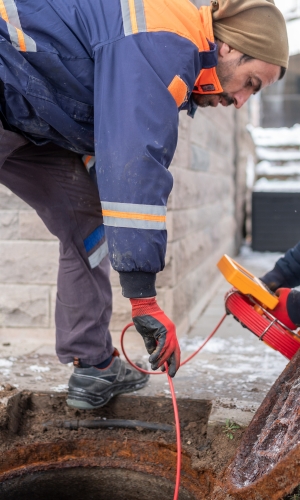
A sewer camera inspection is the only way to make a repair-or-replace decision based on actual conditions rather than assumptions. The camera runs through the full length of the lateral line and produces video footage showing the pipe material, the location and nature of any damage, the condition of the joints, root mass density, whether any sections have bellied or collapsed, and the overall structural integrity of the line.
At Dan’s Drains and Digs, we run the camera before recommending anything. The footage is yours — you see exactly what we see, and the recommendation follows from what’s in the line, not from what’s most profitable to suggest.
Frequently Asked Questions
The repair-or-replace question doesn’t have a universal answer, but it does have a clear process — camera first, then a recommendation based on what’s actually in the line. Most homeowners in older Colorado Springs neighborhoods are dealing with clay or cast iron pipe that’s been in the ground for 50 to 70 years, and many of those lines have more life left with the right repair. Some don’t.
If your sewer line is giving you signs, the right move is to get eyes on it before the situation forces a decision under pressure. Call Dan’s Drains and Digs at (719) 375-8181 or request an inspection online. We’ll run the camera, show you what’s there, and give you a straight answer on what makes sense.